

The latest breakthroughs in quantum computing 2024 turned error correction from a hope into a measured result. Google showed that larger error-correcting codes can cut errors instead of adding them. IBM shipped a faster processor for real work in November 2024. Microsoft and Quantinuum built steadier logical qubits during the same year. Each breakthrough below comes with dates, numbers, and honest limits.
Quantum Computing in Simple Words
Quantum computing uses quantum physics to solve certain problems in a different way. A quantum computer stores information in qubits, the basic units of quantum information. A normal computer bit holds a 0 or a 1, while a qubit can hold a blend of both at once. Superposition is the name for that blend of 0 and 1 in one qubit. Entanglement links qubits so that measuring one reveals facts about another. Together, those two traits let a quantum computer test many possible answers at the same time. Quantum computers suit only some problems, such as modeling molecules, searching large sets, or factoring large numbers. A physical qubit is one real hardware unit, while a logical qubit combines many physical qubits into one steadier unit. Fault-tolerant quantum computing means running long programs on logical qubits without errors taking over. The physical qubit vs logical qubit gap decides how useful any machine can be. Researchers call today’s machines NISQ machines, a short name for noisy machines with tens to hundreds of qubits. The table below defines the key terms in one short line each.
| Term | What it means in plain words |
|---|---|
| Qubit | The basic unit of quantum information |
| Superposition | A qubit holding a blend of 0 and 1 |
| Entanglement | A link between qubits that ties their results together |
| Physical qubit | One real hardware unit on a chip |
| Logical qubit | Many physical qubits working as one steadier unit |
| Fault-tolerant quantum computing | Long programs that keep working despite errors |
| NISQ era | The current stage: noisy machines with few hundred qubits |
| Surface code | A grid layout that spreads one logical qubit across many physical qubits |
| Shor’s algorithm | A quantum method for factoring large numbers fast |
| Post-quantum cryptography | New encryption built to resist quantum attacks |
The 2024 Breakthroughs at a Glance
The table below lists the main 2024 breakthroughs, with the date, the team, and the reason each one matters.
| Date in 2024 | Who | Breakthrough | Why it matters |
|---|---|---|---|
| 27 March | IBM | Bivariate bicycle code for error correction | 12 logical qubits fit in 288 physical qubits |
| 3 April | Microsoft and Quantinuum | Four logical qubits with far lower error rates | Error correction started beating raw hardware |
| 13 August | NIST | First three post-quantum cryptography standards | The world gained official quantum-safe encryption rules |
| 13 November | IBM | Heron R2 processor with 156 qubits | Real circuits ran deeper and faster than before |
| 19 November | Microsoft and Atom Computing | 24 entangled logical qubits | Neutral-atom machines joined the logical-qubit race |
| 9 December | Willow chip with below-threshold error correction | Bigger codes finally meant fewer errors |
2024 Month by Month
The year moved in clear steps, from a new code design in spring to a new chip in December.
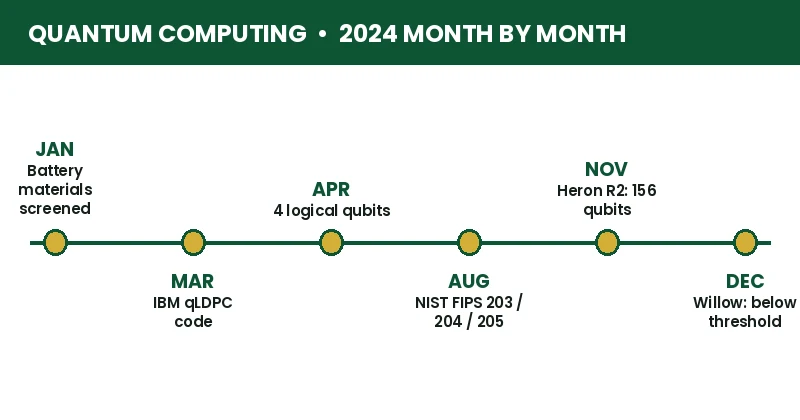
- In January, Microsoft worked with a United States national laboratory to screen 32 million battery materials. The screening used AI and high-performance computing to test each candidate fast.
- In March, IBM published a new error-correction code design that packs 12 logical qubits into 288 physical qubits.
- In April, Microsoft and Quantinuum reported four logical qubits with error rates 800 times lower than raw hardware.
- In August, NIST finalized the first three post-quantum cryptography standards after eight years of testing.
- In November, IBM unveiled Heron R2, a 156-qubit processor built for deeper circuits.
- In the same month, Microsoft and Atom Computing entangled 24 logical qubits on neutral-atom hardware.
- In December, Google announced Willow, a 105-qubit chip that proved error correction can improve with scale.
1. Google Willow: Error Correction That Gets Better as It Grows
Google announced Willow on 9 December 2024, a 105-qubit superconducting processor built for error correction tests. The team tested surface codes of growing size, from 3 by 3 grids to 5 by 5 grids to 7 by 7 grids. Each step up roughly halved the logical error rate, a result the Nature paper calls below-threshold error correction. The largest code reached a logical error rate near 0.143 percent per cycle, with a suppression factor of 2.14 per step. Willow also ran a test calculation in under five minutes, a job Google estimated would take a leading supercomputer 10 septillion years. The speed test used a benchmark with no business use, so the error-correction result matters far more. A second test decoded errors in real time on a smaller chip, keeping pace with the machine cycle. Willow proved one protected qubit can hold its memory, not that a full quantum computer now exists.
2. IBM Heron R2: More Useful Work From Today’s Qubits
IBM unveiled Heron R2 on 13 November 2024, a 156-qubit processor aimed at useful work rather than records. Heron R2 can run circuits with up to 5,000 two-qubit gate operations, a measure of how deep a calculation can go. IBM also finished its 100 by 100 challenge, running circuits on 100 qubits with a depth of 100 gates. The same test circuits from a 2023 IBM experiment ran about 50 times faster on Heron R2, according to IBM. A second 2024 result appeared in Nature in March, a new error-correction code design called the bivariate bicycle code. The design, known as the gross code, protects 12 logical qubits with 288 physical qubits in simulation. A surface code would need nearly 3,000 physical qubits for the same protection, so the saving is about tenfold. The code remains a design on paper, since no chip yet wires qubits together in the way it needs. Qiskit software and cloud access let researchers run Heron jobs from anywhere in the world.
3. Microsoft and Quantinuum: Logical Qubits You Can Trust More
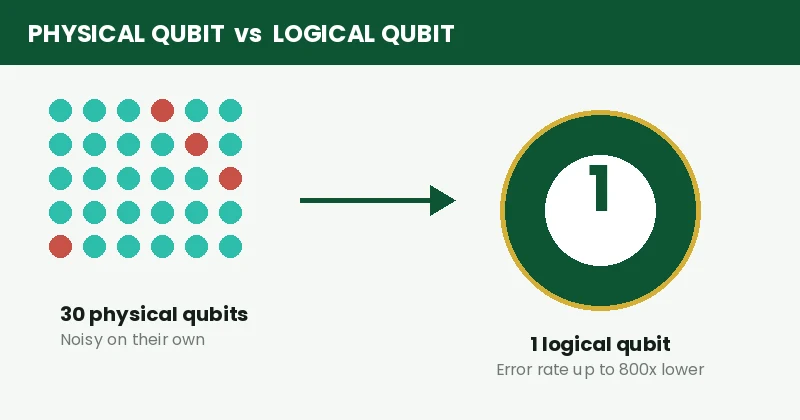
Microsoft and Quantinuum announced their result on 3 April 2024, using Quantinuum’s H2 trapped-ion processor. The teams built four logical qubits from 30 of the 32 physical qubits on the machine. Many readers ask what is a logical qubit in plain words. The short answer is a steadier unit built from many physical qubits. Those logical qubits showed error rates up to 800 times lower than the physical qubits beneath them. The teams ran 14,000 circuit tests without a single error that the code could not catch. The Microsoft Quantinuum result set a new bar for logical qubit reliability. The result used active syndrome extraction, a check that finds errors while a calculation runs. Microsoft and Atom Computing added a second result on 19 November 2024, entangling 24 logical qubits on neutral-atom hardware. The same project ran a computation on 28 logical qubits built from 112 atoms. Counts like these hide real differences, since each team defines and tests logical qubits in its own way. Readers should ask for the logical error rate, not the count, before judging any such claim.
4. Quantum Computing Starts Helping With Real Chemistry and Materials
Quantum hardware earned its keep in 2024 by joining AI and supercomputers, not by replacing them. Hybrid quantum-classical computing pairs quantum steps with normal computers for one job. In January, Microsoft and Pacific Northwest National Laboratory screened 32 million battery materials in 80 hours. The screening narrowed the list from 32 million candidates to 18 finalists. Lab tests then turned one finalist into a working battery prototype. The new material could cut lithium use in batteries by up to 70 percent, according to Microsoft. AI and high-performance computing did the screening here, while quantum tools sat in the same research platform. Quantum chemistry still needs better hardware before it can model large molecules on its own. Drug discovery, catalyst design, and battery research lead the list of near-term uses for quantum methods.

5. Post-Quantum Cryptography Becomes Official
The National Institute of Standards and Technology finalized three post-quantum cryptography standards on 13 August 2024. The standards close an eight-year public process that tested candidate algorithms from researchers around the world. Each standard names one algorithm for a different job, as the table below shows.
| Standard | Algorithm | Job |
|---|---|---|
| FIPS 203 | ML-KEM (from Kyber) | Agreeing on a shared secret key |
| FIPS 204 | ML-DSA (from Dilithium) | Signing data with a digital signature |
| FIPS 205 | SLH-DSA (from SPHINCS+) | Signing data with a hash-based backup method |
The NIST post-quantum cryptography standards give every organization the same target to build toward. The standards protect data against future quantum computers, not against attacks that exist today. The danger has a name: harvest now, decrypt later, where attackers store encrypted data today and open it years later. A large quantum computer running Shor’s algorithm could one day break RSA and elliptic curve encryption. No machine today comes close to that power, so migration is preparation, not panic. The United States government plans a full switch to quantum-safe encryption by 2035. A fourth standard, FIPS 206, stayed in draft form through 2024. An organization can start migration with six plain steps.
- List every system that stores sensitive data for more than five years.
- Find the encryption that each listed system uses today.
- Note every place where RSA or elliptic curve code appears.
- Test the new NIST standards in one low-risk system first.
- Set a written date for full migration across the organization.
- Keep a live list of systems that still need new encryption.
How the Main Quantum Computers Compare in 2024
Different companies bet on different hardware for building qubits. Each type trades speed for accuracy in its own way.
| Qubit type | Leading teams in 2024 | Strengths | Limits |
|---|---|---|---|
| Superconducting | Google, IBM | Fast gates, proven factories | Needs near absolute zero cold |
| Trapped ion | Quantinuum, IonQ | High accuracy, long qubit life | Slower gates, complex laser control |
| Neutral atom | Pasqal, QuEra, Atom Computing | Large arrays, flexible layout | Newer platform, still maturing |
| Topological | Microsoft research, others | Built-in error resistance in theory | No proven large-scale device yet |
What Quantum Computers Could Actually Do in 2024
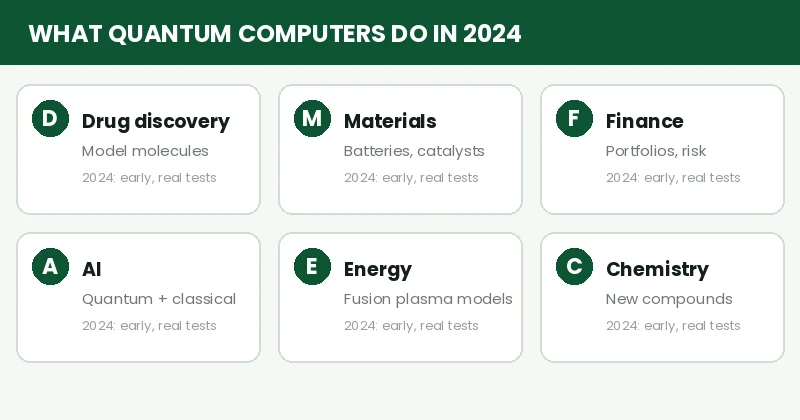
Quantum computing applications in 2024 stayed close to research, with a few early jobs showing real promise. These quantum computing use cases share one trait: narrow problems with clear math behind them. Quantum computing in drug discovery means modeling how molecules bind to targets. Materials science follows, with battery parts, catalysts, and new compounds as the main targets. Quantum computing in chemistry helps researchers test catalysts and battery parts faster. Quantum computing in finance tests portfolio choices and risk models on small problems. Most finance tests still run on simulators, not on real quantum chips. AI work also began to mix quantum steps into larger classical pipelines, with quantum chips handling narrow tasks. Generative AI stays separate from quantum computing, though both fields now share tools and talent. Quantum computing vs classical computing is the wrong contest, since each type suits different problems. Normal computers will keep doing most work, while quantum machines take the few jobs they suit best. Energy teams tested quantum models for fusion plasma, a hard physics problem with few shortcuts.
How to Tell Real Progress From Hype
Headlines often blur lab tests with real products, so use the table below as a quick check. Quantum advantage means a quantum machine beats the best classical method on a useful job.
| Claim you may read | What the evidence showed in 2024 |
|---|---|
| Willow finished a job in five minutes that takes ages | The test was a benchmark with no business use |
| Quantum computers will break encryption soon | No machine today can run Shor’s algorithm at scale |
| More qubits always means a better machine | Error rates and circuit depth matter more than count |
| Quantum computers will replace normal computers | Quantum machines suit narrow problems, not everyday work |
| A new chip proves fault tolerance has arrived | Willow proved one memory, not a full working computer |
Ask these four questions before trusting any quantum claim.
- Does the result give a logical error rate, not just a qubit count?
- Did the error rate fall when the code grew larger?
- Was the result published in a peer-reviewed journal or only in a press release?
- Does the claim name a real use, or does it only cite a speed test?
What Should You Do Now?
Business leaders should treat 2024 as a year to learn, not a year to buy quantum hardware. Pick one hard problem in chemistry, logistics, or finance for a small pilot team. Start with a pilot, since a pilot costs far less than a machine. A small pilot shows whether quantum methods help your data before you spend real money.
Your IT team should start the encryption inventory now, since migration takes years, not months. List the data that must stay secret for ten years or more, then rank it by risk. Data governance frameworks give teams a ready structure for that inventory and the rules around it. Generative AI in cybersecurity already changes how teams triage alerts, so quantum planning should sit beside AI planning.
Students should learn linear algebra and Python first, since both skills open every door in this field. Quantum courses make sense after that base, not before it. Free simulators let you run small quantum programs on a laptop, with no hardware to buy.
How to Try Quantum Computing Yourself
Quantum cloud computing rents time on real machines, so you need no hardware of your own.

- Open a free IBM Quantum account to access real machines and learning material.
- Run a small tutorial circuit on a simulator before spending any real machine time.
- Use the Open Plan free minutes, up to 10 minutes of runtime per month, for your first real jobs.
- Compare the same small job on Amazon Braket and Azure Quantum to learn how platforms differ.
- Work through the free Qiskit textbook course before trying larger circuits.
IBM lists the Open Plan as free, with paid time starting at 96 dollars per minute, on its pricing page in November 2026.
What Is Still Holding Quantum Computing Back
Quantum computing challenges still stand between today’s machines and useful fault-tolerant computers.
- Scaling to millions of qubits will need far better error correction than any team has shown.
- Noise from heat, vibration, and stray fields still corrupts fragile qubits during long runs.
- Only a few problem types have proven quantum speedups, while most everyday tasks gain nothing.
- Moving the world to post-quantum encryption will take years of testing, updates, and replacements.
- Skilled people remain scarce, since the work needs physics, engineering, and software skills together.
What Comes Next After 2024
The next test is simple: more logical qubits with lower error rates on real hardware. Watch for deeper circuits and steadier logical qubits on real hardware. Roadmaps point to larger fault-tolerant machines near the end of the decade, but dates on roadmaps are targets, not promises. IBM targets a fault-tolerant machine called Starling for 2029, with 200 logical qubits in its plan. The latest breakthroughs in quantum computing 2024 gave the field proof that reliability can improve with scale.
Conclusion
The latest breakthroughs in quantum computing 2024 made reliability the main story, ahead of qubit counts. Heron R2 did more useful work, while NIST gave the world new encryption rules. The machines remain early, costly, and hard to run, so steady progress beats bold promises. Readers who track logical error rates, not qubit counts, will see the real story first.
Frequently Asked Questions
What is quantum computing?
Quantum computing uses qubits and quantum physics to solve certain problems in a new way. Normal computers suit most work, while quantum computers suit narrow problems like modeling molecules.
How does quantum computing work?
Qubits use superposition and entanglement to test many possible answers at the same time. Error correction groups physical qubits into logical qubits, which hold information far more reliably.
What was the biggest quantum computing breakthrough of 2024?
Among the latest breakthroughs in quantum computing 2024, Google Willow stands out as the biggest result. IBM Heron R2 and the new NIST standards rank just behind Willow.
What is the difference between a physical qubit and a logical qubit?
A physical qubit is one hardware unit, while a logical qubit groups many physical qubits into one steadier unit. Logical qubits matter more than raw counts, since they show how much reliable work a machine can do.
What is quantum error correction?
Quantum error correction spreads information across many physical qubits so errors can be found and fixed. The method works only below a threshold error rate, where bigger codes mean fewer errors.
Can quantum computers break encryption yet?
No quantum computer today can break RSA or elliptic curve encryption at real-world scale. NIST set new standards in 2024 so organizations can move to quantum-safe encryption before that day arrives.
Will quantum computers replace normal computers?
Quantum computers will work beside normal computers, taking narrow jobs that suit their strengths. Normal computers stay faster and cheaper for everyday work, from email to video editing.
Is quantum computing useful today?
Quantum computing helps research today, in chemistry, materials science, and small pilot projects. Broad practical advantage over the best classical computers remains limited to narrow tests.
What is quantum computing used for?
Quantum computing suits narrow jobs like modeling molecules, testing materials, and pricing risk. Research comes first, since broad business use still needs better hardware.
Is quantum computing real?
Quantum computing is real, with cloud machines running research jobs today. The limits are real too, since no machine yet beats normal computers on everyday work.
Should I learn quantum computing?
Learn linear algebra and Python first, then add quantum basics through a free online course. Free simulators and cloud accounts let you practice on real machines without buying hardware.
References
- National Institute of Standards and Technology, “NIST Releases First 3 Finalized Post-Quantum Encryption Standards,” 13 August 2024. https://www.nist.gov/news-events/news/2024/08/nist-releases-first-3-finalized-post-quantum-encryption-standards
- National Institute of Standards and Technology, Post-Quantum Cryptography Standardization project page. https://csrc.nist.gov/projects/post-quantum-cryptography/post-quantum-cryptography-standardization
- Google Quantum AI and collaborators, “Quantum error correction below the surface code threshold,” Nature 638, 920-926 (2024). doi:10.1038/s41586-024-08449-y
- Bravyi, Cross, Gambetta and others, “High-threshold and low-overhead fault-tolerant quantum memory,” Nature (2024). doi:10.1038/s41586-024-07107-7
- IBM, “Landmark IBM error correction paper on Nature cover,” IBM Quantum Computing Blog, 27 March 2024. https://www.ibm.com/quantum/blog/nature-qldpc-error-correction?sf187343338=1
- Quantinuum and Microsoft, “Quantinuum partners with Microsoft in new phase of reliable quantum computing,” press release, 3 April 2024.
- Microsoft and Atom Computing, reported in the Microsoft Azure Quantum Blog, 19 November 2024.
- IBM, Heron R2 announcement, IBM Quantum Developer Conference, 13 November 2024.
- Microsoft and Pacific Northwest National Laboratory, Azure Quantum Elements battery material screening, January 2024.
- IBM, IBM Quantum products and pricing page, accessed November 2026. https://www.ibm.com/quantum/products