

Edge AI for real-time analytics runs AI models on devices near the data source, so decisions happen in milliseconds instead of waiting for a cloud server.
A camera spots a defect on a production line.
A sensor flags a failing pump before the next unit passes.
Each event gets an answer on the spot, in milliseconds.
Edge AI moves analysis to the place where data is born.
The cloud keeps the slower jobs that can wait for later.
Gartner predicted in 2018 that 75 percent of enterprise data would be created and processed outside centralized data centers by 2025.
The same forecast put the 2018 share at about 10 percent.
BCC Research values the global edge AI market at $8.7 billion in 2024.
The same firm projects $56.8 billion by 2030, at a 36.9 percent compound annual growth rate.
ResearchAndMarkets counts hardware, software, and services in one total.
Its total reaches $49.3 billion for 2024 and $82 billion for 2030.
Other analysts size the market differently because definitions of edge AI vary widely.
What Is Edge AI?
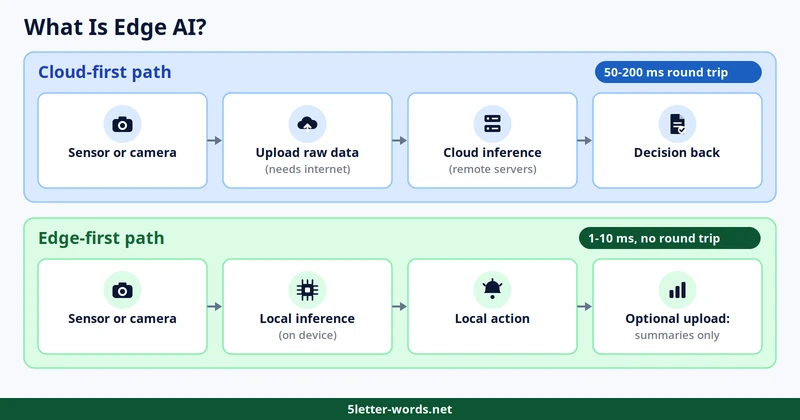
Edge AI means running AI models on local devices, close to the sensors and machines that create data.
Edge computing supplies local processing power near the data source.
Edge AI adds the intelligence layer that turns raw data into action.
A trained model sits on a camera, a gateway, or a small server.
The model scores each new input as the input arrives.
The difference from cloud AI is the location of the work, not the idea of the model.
Cloud AI sends raw data to a distant data center.
The answer travels back to the device after the model runs.
Edge AI keeps the same scoring step on the device, so the answer never leaves the site.
Analysts often use the term edge inference for this on-device scoring step.
Edge AI covers more than inference alone, since model updates and monitoring also run across edge systems.
Most edge AI systems still train models in the cloud, then ship smaller versions to devices for daily use.
Each model is a neural network trained on past examples.
The network learns patterns that humans would miss in raw sensor streams.
Edge computing vs edge AI confuses many readers, since the terms overlap yet mean different layers.
Edge AI for IoT devices follows the same pattern, since sensors and machines generate the data.
Real-time analytics adds a time limit to this setup: the answer must arrive fast enough to change the next physical event.
Each action needs that speed: a press stops, a gate opens, a patient gets flagged.
Sensor fusion combines camera, radar, and vibration data into one picture of the scene.
How Edge AI Works
How does edge ai work in practice on a factory floor or a hospital ward?
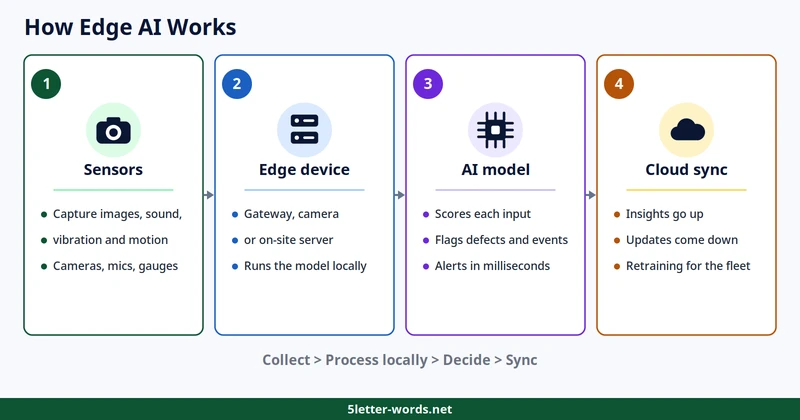
Four parts work together in most edge AI systems: sensors, edge devices, AI models, and a link to the cloud.
The Four Parts of an Edge AI System
Sensors capture the raw signal: camera frames, vibration readings, temperature, pressure, and sound.
An edge device sits beside the sensors with the model loaded on local chips.
AI models read the signal, then return a score, a label, or an alert.
The cloud link carries model updates down to devices.
Summaries travel up for retraining across the whole fleet.
A gateway often sits between devices and the cloud, since one gateway can serve many sensors at a site.
Gateways also filter the stream, so only useful results and exceptions reach the cloud.
Devices talk to gateways over lightweight protocols built for weak links.
MQTT carries small sensor messages, while video uses RTSP or WebRTC streams.
Event backbones such as Kafka move the filtered results onward to cloud systems.
Training in the Cloud, Inference at the Edge
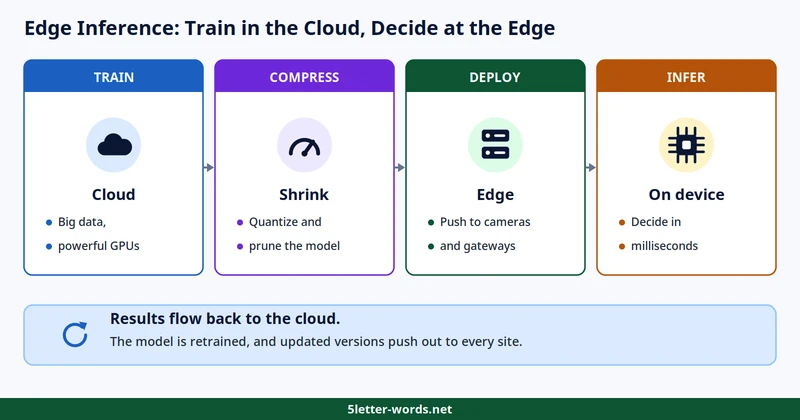
Training needs far more compute than inference, so teams train models on cloud GPUs with large labeled datasets.
Training runs once, or on a schedule, while inference runs all day on every device.
After training, engineers compress the model with quantization and pruning.
Quantization shrinks model size by cutting the precision of stored numbers.
Pruning removes weak connections that add little to accuracy.
Compressed models fit on small chips, yet keep most of their accuracy on narrow tasks.
Devices run the compressed model locally, then send hard cases back to the cloud for review.
Those hard cases join the next training set, so the model improves with each cycle.
Engineers call this loop the edge inference cycle in deployment guides.
The loop keeps models fresh without constant cloud traffic.
Teams pick from many machine learning algorithms for the scoring step.
Simple decision trees suit clear rules, while deep neural networks suit images and sound.
Edge AI vs Cloud AI
The two approaches differ on every factor that matters for real-time work.
The table below compares edge AI and cloud AI across the factors that decide a deployment.
| Factor | Edge AI | Cloud AI |
|---|---|---|
| Where processing happens | On the device or a local gateway | In a distant data center |
| Latency | 1-10 ms on optimized hardware | 50-200 ms per round trip, up to 500 ms in production |
| Bandwidth use | Only results and exceptions travel | Raw video and sensor streams travel |
| Privacy | Raw data stays on site | Raw data leaves the site |
| Offline operation | Works without internet | Stops when the link drops |
| Cost pattern | Hardware up front, low cost per decision | Little hardware, cost per call |
| Best fit | Safety, control, and instant action | Fleet-wide analysis and heavy training |
Cloud AI wins when a job needs huge compute or data from many sites at once.
Edge AI wins when a decision must land before the next physical event.
Most production systems mix the two approaches in one pipeline.
Edge devices handle instant decisions, while the cloud handles retraining.
The right question asks where each job belongs: device, gateway, or cloud.
Why Real-Time Analytics Needs the Edge
Real-time analytics earns its name from a deadline, not from a dashboard.
A cloud round trip adds delay at every stage.
Delay grows further when networks get busy or links degrade.
Edge AI for real-time analytics exists for exactly this deadline.
Real-time analytics at the edge means the answer arrives before the next event, not after it.
Edge AI latency is the gap between a cloud answer and a local answer.
A 2026 technical briefing from Intellisee breaks a cloud video pipeline into stages.
Each stage adds its own delay to the total.
The table below shows the usual delay at each stage for the same video task.
| Pipeline stage | Edge AI | Cloud AI |
|---|---|---|
| Frame capture | 1-5 ms | 1-5 ms |
| Local encoding | 2-5 ms | 2-5 ms |
| Network upload | None | 50-150 ms |
| Queue at the service | None | 10-50 ms |
| Model inference | 5-20 ms | 20-50 ms |
| Result return | None | 50-150 ms |
| Total, typical | About 10-40 ms | 150-400 ms |
A 250-millisecond delay sounds small, yet it spans seven or eight video frames at 30 frames per second.
That delay changes the outcome for a press, a gate, or a medical alert.
Edge devices skip the upload, the queue, and the long return trip.
Edge inference removes the network legs, so the same model answers in 5-20 milliseconds.
People react in roughly 200 milliseconds, so a cloud delay can feel slow beside an edge answer.
Energy adds a second reason to move analysis closer to the data.
The International Energy Agency estimates that data centers used about 415 terawatt-hours of electricity in 2024, around 1.5 percent of global demand.
Its base case puts that figure near 945 terawatt-hours by 2030, just under 3 percent of global demand.
United States data centers used 176 terawatt-hours in 2023, about 4.4 percent of national electricity, according to Lawrence Berkeley National Laboratory.
Local inference trims the load in two clear ways.
Skipping the round trip removes the network legs from every decision.
Sending only results keeps raw video off the network.
Edge hardware still draws power, so the saving comes from avoided traffic and smaller data center loads, not from free compute.
The saving also shows in response time rather than watts.
Benefits of Edge AI
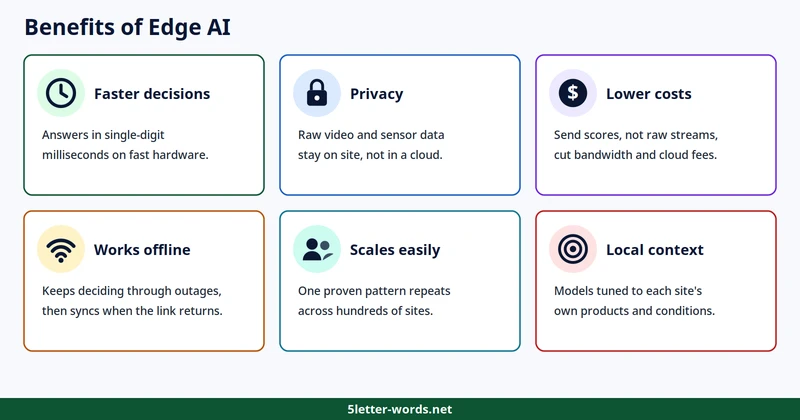
Edge AI benefits start with speed, yet privacy, cost, and scale matter too.
Six benefits explain why teams move real-time work to the edge.
Lower latency leads the list, since on-device inference answers in single-digit milliseconds on optimized hardware.
Safety shutoffs, machine control, and instant alerts all need that speed.
Stronger privacy follows, since raw video and sensor data can stay on site instead of crossing networks.
Local processing also helps teams meet data rules that limit where personal or industrial data may travel.
Hospitals and banks gain the most here, since their data faces the strictest rules.
Lower bandwidth use comes next, since edge devices send scores and alerts rather than raw streams.
A site with one hundred cameras saves the most, since video dominates network traffic.
Offline reliability matters at remote sites with weak or missing links.
Edge models keep working through an outage, then sync results when the link returns.
Lower cost at scale comes from cutting per-call cloud fees on high-volume decisions.
A factory that scores every part on a line pays once for hardware, not once per part.
Faster scaling rounds out the list, since new sites need only a device and a model, not a data center build.
Fleet tools push one model to hundreds of sites at once, then track drift from a central dashboard.
Edge AI Hardware
Hardware choice sets the ceiling for model size, speed, and power draw.
Edge AI devices range from tiny sensors to rack-mounted servers.
Four classes cover most deployments: a GPU module, a neural processor, a dedicated accelerator, and a small edge server.
The table below compares the four classes on compute, power, and fit.
| Hardware class | Example | Compute | Power | Best fit |
|---|---|---|---|---|
| GPU module | Jetson AGX Orin | Up to 275 TOPS (sparse INT8) | 15-60 W | Multi-camera vision, robotics |
| Neural processor (NPU/TPU) | Google Coral Edge TPU | 4 TOPS | About 2 W | Single-camera detection, sensors |
| Dedicated accelerator | Hailo-8 | 26 TOPS | A few watts | Video analytics at many sites |
| Edge server | Server GPU appliance | 100+ TOPS | 70 W or more | Heavy multi-model pipelines |
One TOPS equals one trillion AI operations per second.
The figure suits rough comparison only, since real speed depends on the model and the software stack.
Memory and power often matter more than TOPS, since a model that cannot fit cannot run.
Teams should test their own model on shortlisted hardware before buying in volume.
Power budgets decide the class, since a battery sensor cannot feed a GPU module.
Our guide to AI chips tracks new silicon for edge and data center work.
Edge AI Use Cases and Examples
Five sectors show the pattern most clearly: factories, hospitals, stores, cities, and power grids.
All edge ai examples share one pattern: decide locally, sync globally.
Manufacturing
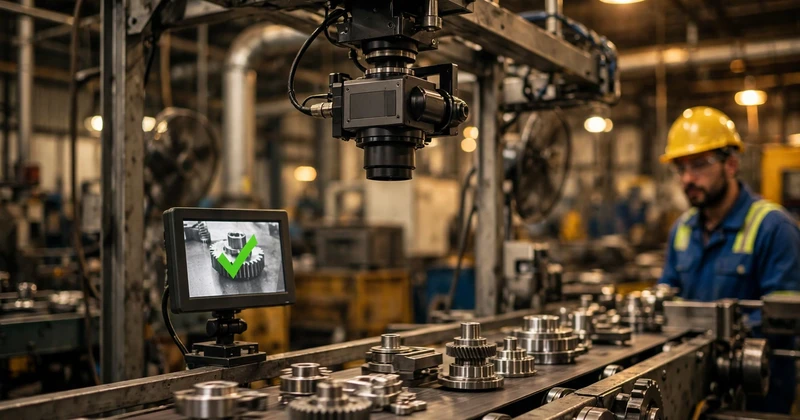
Edge AI in manufacturing starts with vision cameras that inspect every part at line speed.
A model flags a crack or a misaligned weld in milliseconds, so the line stops before scrap piles up.
Sensor trends feed predictive analytics that flag a breakdown days ahead, so crews fix the machine during planned downtime.
Our earlier guide to computer vision explains how cameras read parts, labels, and gauges on the line.
Healthcare
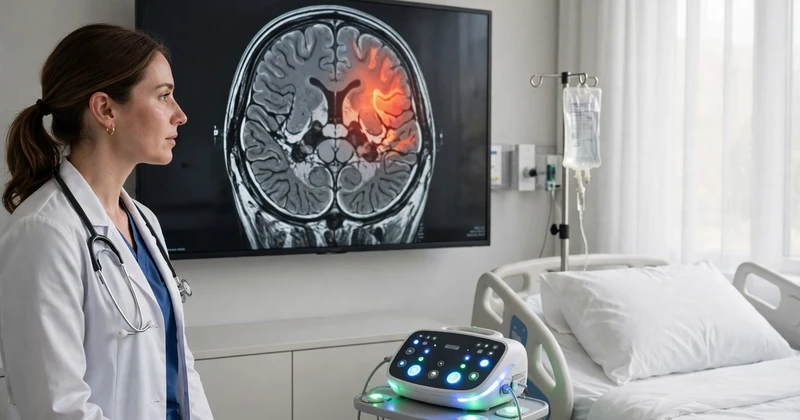
Edge AI in healthcare starts with bedside monitors and imaging tools that need answers in seconds.
Edge models read scans, flag anomalies, and watch vital signs at the point of care.
Patient data stays inside the hospital network, which eases privacy rules and audit work.
Surgical robots and fall-detection cameras also belong here, since a lost link must never stop the system.
Retail

Edge AI in retail starts with shelf cameras that spot empty facings.
Checkout cameras flag scan errors and shrink at the till.
Queue sensors count shoppers at each till, so managers open new lanes before lines grow.
Quick-service kitchens use edge cameras to check each order against the ticket before handoff.
Personalization runs on the same feed, with offers built from the current basket rather than a cloud profile.
Smart Cities
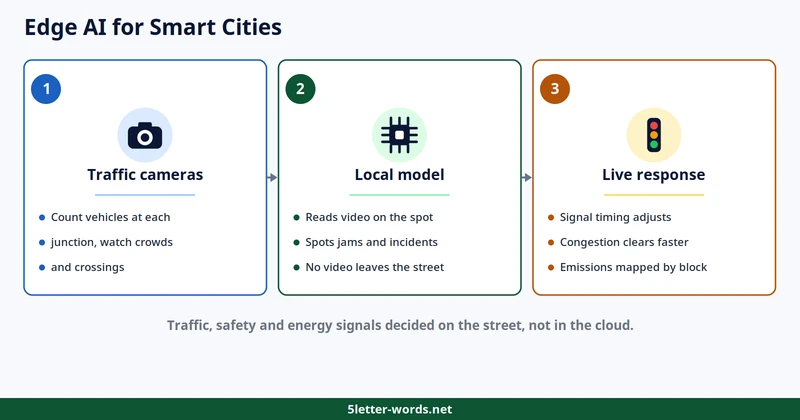
Edge AI for smart cities starts with traffic cameras that count vehicles at each junction.
Signal timing adjusts from live counts, so congestion clears faster after an incident.
Grid sensors balance local loads as electric vehicles and heat pumps spread.
Emission sensors map pollution block by block, so cities act on live data instead of monthly reports.
Energy and the Grid
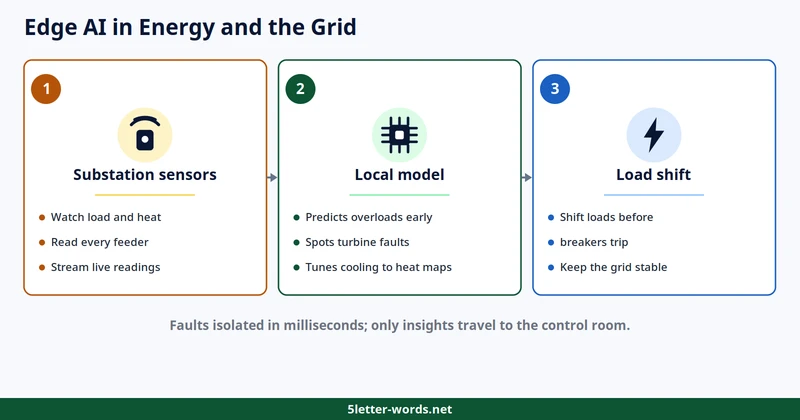
Edge AI in energy starts with substation sensors that watch load and heat.
Grid operators face a hard problem: renewable output swings with weather, while demand peaks without warning.
Edge AI reads substation sensors, predicts overloads, and shifts loads before breakers trip.
Wind and solar farms use the same approach to spot turbine faults early.
Data center cooling offers a clear example, since edge models tune fans and pumps against live heat maps.
Logistics and Delivery
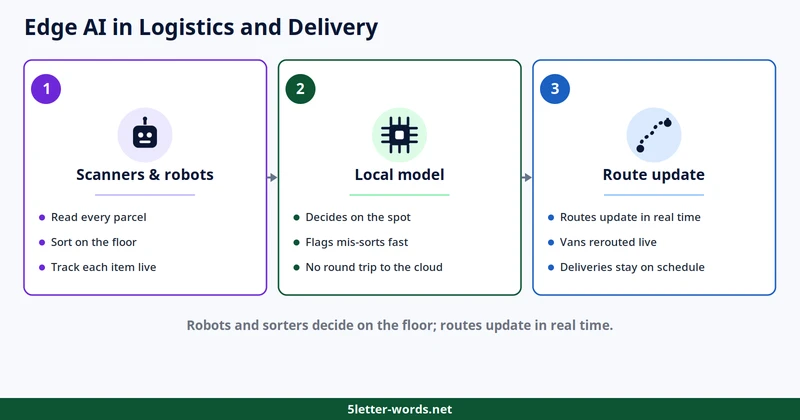
Delivery robots and warehouse vehicles read their surroundings on board, since a cloud delay could stop a robot mid-aisle.
Warehouse cameras count pallets, track forklifts, and flag blocked lanes without a control room.
Challenges of Edge AI
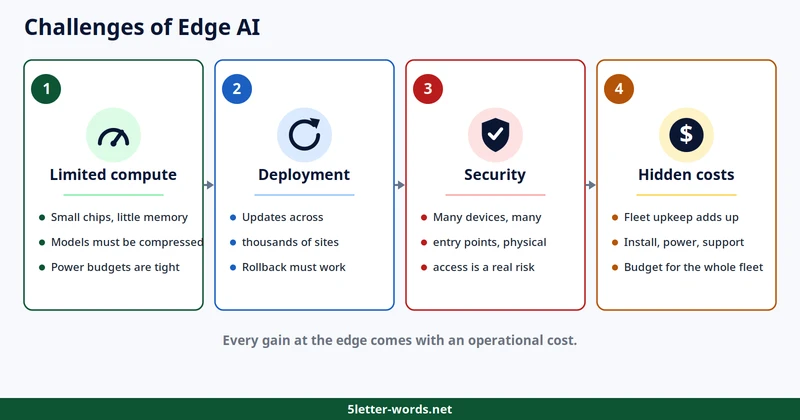
Edge AI challenges fall into four groups: compute, deployment, security, and cost.
Limited Compute and Power
Edge chips trade power for size, so large models must shrink before they can run.
Quantization and pruning help, yet accuracy can slip on tasks the compressed model never saw in training.
Teams should measure accuracy on their own data, not on vendor benchmark slides.
Model Deployment and Maintenance
A fleet of devices is a fleet of versions.
One stale model can skew results across many sites.
Updates must reach devices over weak links, then install without stopping the line.
Model drift adds a quiet risk, since sensor wear and season shifts change the data a model sees.
Central dashboards should track version, accuracy, and drift on every device.
Rollback plans matter as much as updates, since a bad model must leave the fleet fast.
Security at the Edge
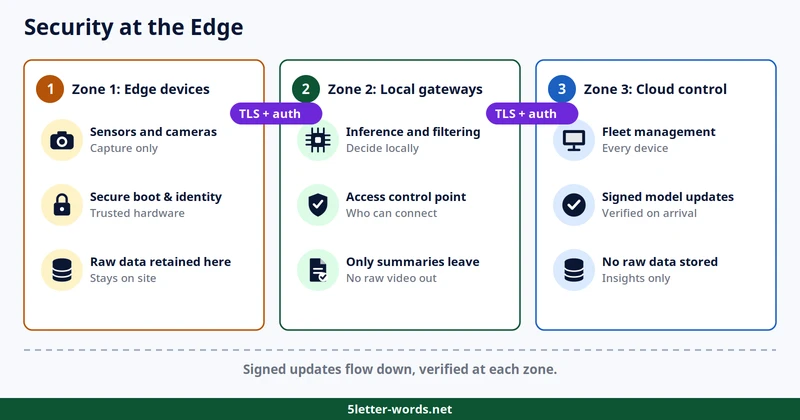
Edge AI security starts with the device itself, not with the network.
Every edge device is a physical target, so locks, sealed cases, and tamper alarms matter.
A stolen device can expose its model and its keys.
All device storage stays encrypted, even when the device is powered off.
Key rotation runs on a quarterly schedule across the fleet.
Network traffic needs the same care, since unencrypted model updates invite tampering.
Data rules add a legal layer: the EU AI Act entered into force on 1 August 2024, with high-risk duties phasing in through 2 December 2027.
Strong data governance turns these rules into daily practice rather than a one-off audit.
Teams in regulated sectors should map each model against the NIST AI Risk Management Framework, released in January 2023.
Costs That Catch Teams by Surprise
Hardware, installation, and fleet software add up before the first decision runs.
Cloud fees look small per call, yet they grow with every camera and every frame.
Retraining, labeling, and support contracts hide in the second year, not the first.
A pilot budget should cover the full year, including updates, monitoring, and one hardware refresh.
How to Implement Edge AI
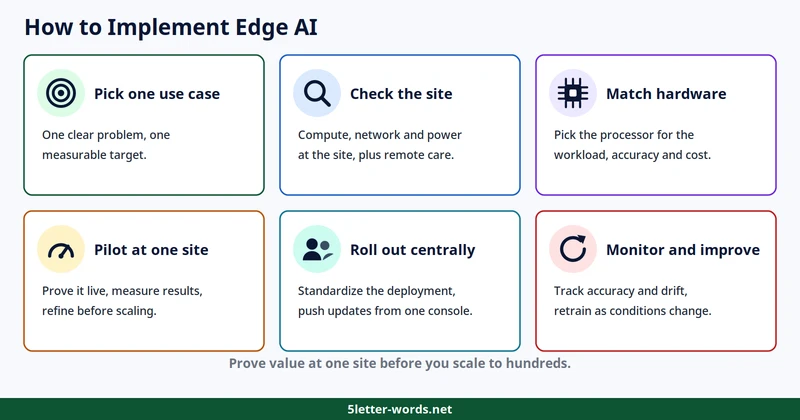
How to implement edge AI starts with a small win, not with a fleet-wide plan.
Six steps carry a pilot from a single use case to a fleet rollout.
- Define one use case with a clear decision and a measurable result.
- Measure the baseline latency, cost, and accuracy of the current process.
- Pick hardware that fits the model, the site, and the power budget.
- Run a pilot on one site with live data and real operators.
- Roll out in waves, with central tools for updates and monitoring.
- Review accuracy and drift monthly, then retrain on the hard cases.
Each step needs a named owner and a date, or the pilot drifts.
Pilot success needs three numbers: latency before and after, accuracy on live data, cost per decision.
Edge AI Costs and ROI
Cost decides more pilots than technology does, so the numbers deserve a clear table.
The matrix below matches common jobs to the deployment that usually pays.
| Job | Best deployment | Why |
|---|---|---|
| Sub-10 ms safety control | Edge | No network leg in the loop |
| Video analytics at 100+ cameras | Hybrid | Edge filters, cloud archives |
| Fleet-wide model retraining | Cloud | Needs pooled data and GPUs |
| Batch reports and trends | Cloud | No deadline on the answer |
| Offline or remote site | Edge | No link to depend on |
| Regulated data that must stay local | Edge | Data never leaves the site |
Return on investment usually comes from avoided downtime, fewer false alarms, and lower cloud bills.
Teams should price the pilot against the cost of one failure, not against zero.
Cloud inference fees of a fraction of a cent per call still add up at millions of calls per month.
Edge hardware costs once, then serves every decision at the site for years.
A five-year view usually favors edge hardware for high-volume sites, since cloud fees never stop.
What Is Next for Edge AI
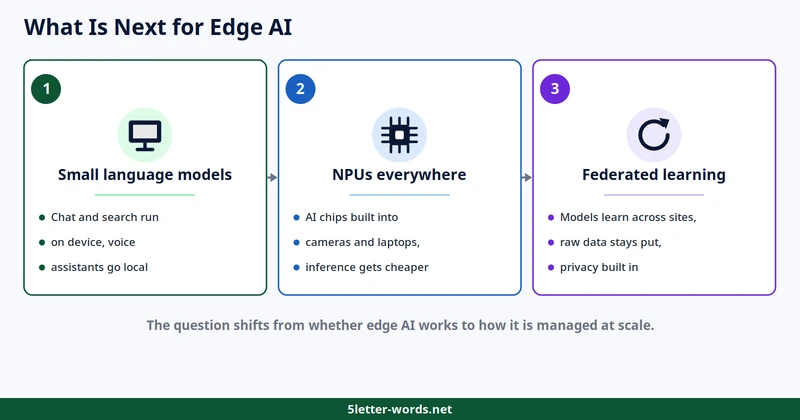
Small language models lead the next wave, since they run useful assistants on modest edge chips.
Chip makers now ship neural processors inside standard laptops, cameras, and phones.
The question shifts toward fleet management: one model, many sites, constant updates.
Federated learning may follow, with devices training shared models without sharing raw data.
Standards will matter more as fleets grow, since mixed hardware needs common deployment rules.
On-device assistants will answer questions from local manuals, without sending plant data to a cloud service.
Conclusion
Edge AI for real-time analytics turns waiting into deciding, by moving the model to the data.
Latency falls to milliseconds when models run on local hardware.
Raw data stays on site instead of crossing networks.
Costs shift from per-call fees to hardware that pays for itself over time.
The best first step is a single pilot with a clear decision, a measured baseline, and a named owner.
What is the difference between edge AI and cloud AI?
Edge AI runs models on local devices near the data source, while cloud AI runs models in distant data centers.
The edge answers in milliseconds, even without an internet link.
The cloud suits heavy training and analysis across whole fleets.
What hardware does edge AI need?
Edge AI needs a device with an AI chip, enough memory for the model, and a sensor or camera feed.
Small tasks run on neural processors, while heavy video needs a GPU module or an edge server.
What is edge inference?
Edge inference means running a trained model on a local device to score new data on the spot.
Training happens in the cloud, while inference happens where the data is born.
Is edge AI more secure than cloud AI?
Edge AI keeps raw data on site, which cuts exposure during transit and storage in distant centers.
Security still needs work, since each device needs encryption, updates, and physical protection.
What are examples of edge AI?
Factory cameras spot defects, hospital monitors flag vital-sign changes, and store cameras track shelf gaps.
Traffic systems, grid sensors, and delivery robots use the same on-device pattern.
How much does edge AI cost?
Cost depends on hardware, site count, and model work, so a single pilot costs far less than a fleet rollout.
Cloud fees charge per call, at a fraction of a cent each.
One hardware purchase serves every decision at the site for years.
Can edge AI work without internet?
Edge AI works without internet, since models run on local chips.
Results sync to the cloud when the link returns, so nothing is lost.
When should a team choose edge AI over cloud AI?
Teams should choose edge AI when a decision needs milliseconds, data must stay local, or links are weak.
Cloud AI fits jobs with no deadline, huge datasets, or a need for fleet-wide comparison.
References
1. International Energy Agency, Energy and AI, April 2025. https://www.iea.org/reports/energy-and-ai
2. BCC Research, Edge AI Market to Grow at 36.9% CAGR, October 2025. https://www.bccresearch.com/pressroom/ift/edge-ai-market-to-grow-at-369-cagr
3. National Institute of Standards and Technology, AI Risk Management Framework 1.0, January 2023. https://www.nist.gov/itl/ai-risk-management-framework
4. Intellisee, Edge vs Cloud AI Inference in Physical Security, 2026. https://intellisee.com/intelligence/edge-vs-cloud-ai-inference-physical-security-technology-briefing/
5. ResearchAndMarkets, Edge AI Market report, via GlobeNewswire, 25 April 2025.
6. Gartner, 2018 forecast on enterprise data created and processed outside centralized data centers.
7. Regulation (EU) 2024/1689, the EU AI Act, EUR-Lex.